
How Korea can get the Bomb

Updated: Jul 17, 2025
The frozen war between the Koreas is one of the oldest unresolved conflicts in the world. The 1953 armistice left the nation divided between two opposing political-economic systems: the capitalist South and the juche North. How Korea can have the bomb.

The status quo established in Korea generated strong incentives for no actor to have any interest in reactivating the conflict. The United States guaranteed a loyal ally in the South, which allowed it to project itself on that shore of the Pacific. On the other hand, for China and the Soviet Union, Kim's Korea served as a “buffer” against the U.S.; moreover, as countries with a direct border with the North, a possible fall of the regime and the consequent refugee crisis was a scenario to be avoided. Japan, as a nation without an army since World War II, would be extremely exposed to any armed conflict in its neighborhood. For that reason, although the situation on the Korean peninsula was not to the liking of either side, the alternative was far worse. As a result, the border has been maintained.

The conflict was also of no interest to the governments of both Koreas. South Korea has undergone accelerated development since the 1990s to become one of the world's leading economic powers. If anything is destructive to business and economic development, it is an all-out war for state survival. To ensure that the North did not take the initiative, the South developed conventional (non-nuclear) military power strong and advanced enough to deter possible incursions.
In contrast, the North's government has historically viewed Seoul as a puppet government of the United States and therefore not “to blame” for the rivalry. North Korea, which has been a poor country, suffered the consequences of the collapse of the Soviet Union and a great famine with the arrival of Kim Jong-il, while considerably strengthening the role of the military in North Korean public life. Despite being very numerous (the fourth largest in the world, behind the US) and the densest on the planet, the North Korean army is poorly equipped and has antiquated equipment. However, this perception of weakness has changed since Pyongyang succeeded in developing the atomic bomb. Since then, it has shifted from viewing the South Koreans as “hostages” of U.S. imperialism to seeing them as potential enemies that can be defeated.
This latest posture is putting South Korean political and military leaders, as well as the Americans, on alert. When one country perceives that it has great military superiority over another, especially if it is a neighbor, it tends to adopt a more aggressive posture in the diplomatic and commercial arenas, among others. This posture intensifies when that superiority is backed by the ultimate weapon: the nuclear weapon.
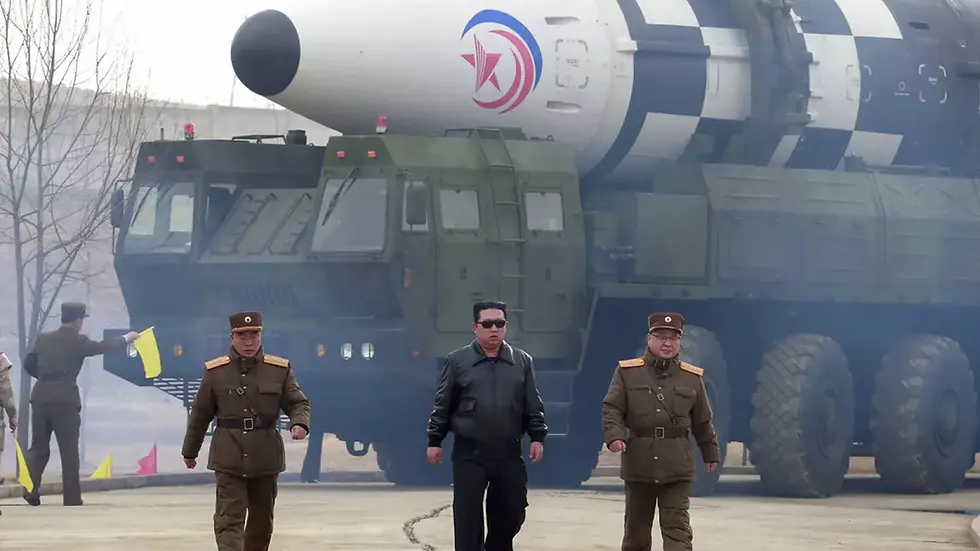
The imbalance of forces on the Korean peninsula is tipping the balance in favor of Kim Jong-un, especially since North Korea has developed intercontinental missiles (Hwasong 14-19 series) with nuclear capability and sufficient range to strike much of US territory, reaching 15,000 km. Thus, in an eventual conflict, U.S. involvement in defense of its South Korean ally is in question, as there are reasonable doubts as to whether a U.S. president would be willing to risk the destruction of Los Angeles or San Francisco to protect Seoul.
Given this reality, the majority of the South Korean population and establishment are increasingly leaning toward developing a nuclear program of their own. Below, we will discuss possible scenarios for restoring a deterrent military balance on the peninsula:
Developing the nuclear bomb: Developing the nuclear bomb: This path envisages the possibility of Seoul developing an autonomous nuclear program, as France, the United Kingdom or Pakistan have done. In this scenario, South Korea would break the Nuclear Non-Proliferation Treaty (NPT), which it signed in 1968 and ratified in 1975. North Korea, for its part, withdrew from the treaty in 2003. At the same time, this could encourage other countries with conflicting neighbors to develop their own nuclear programs. Nations such as Poland, Ukraine, Iran or Taiwan could feel legitimized to take such a step, increasing the risk to global security. Moreover, this decision would affect the power projection of the United States in the region, since, as mentioned above, nuclear powers tend to act more independently and feel more empowered to push their own agenda in the international arena.
The nuclear tupperware: This option could be considered a subtype of the previous one, but it would considerably reduce the prospects for proliferation. It consists of South Korea developing its own nuclear program, but leaving it incomplete by a minimum margin. The underlying idea is that the country does not build the complete nuclear weapon, but has the capability to do so in a few weeks or days. With this strategy, Pyongyang could include in its strategic calculus the possibility of Seoul possessing the nuclear weapon without having it fully developed. The fear that South Korea, faced with an eventual crossing of a red line, could complete its arsenal could act as a sufficient deterrent.
Western Korea: This path envisages a scenario similar to what happened in the Federal Republic of Germany during the Cold War. At that time, West Germany had U.S. nuclear weapons within the NATO framework. While it could benefit from nuclear deterrence on its territory, Bonn did not have the control to activate the missiles. Following this model, a possible increase in tension in the Asia-Pacific region is considered due to the approach of U.S. nuclear warheads to the borders of China and Russia. Moreover, this would significantly implicate the U.S. in an eventual conflict from which it would not be able to shy away.
The consensus within Korea is that obtaining a nuclear weapon is a necessity, and within that consensus, the majority are in favor of developing their own program (70.9%). The option of allowing the hosting of U.S. nuclear warheads also has majority support, although to a lesser extent (63.8%). This support is at historic highs and is closely linked to the growing sense of insecurity. Likewise, confidence that the United States will intervene in the event that North Korea uses the atomic bomb is even lower (53%).
In the context of the exponentially escalating conflict between Israel and Iran since June 13, 2025, motivated by the development of the Iranian nuclear program, it is foreseeable that the Korean peninsula will follow a similar path. North Korea's perception of real risk in the face of a possible nuclearization of the South could legitimize it to carry out a preemptive military intervention.

Against this backdrop, South Korea faces a historic crossroads. The decision to move toward nuclearization will have profound implications for regional stability, international security and strategic alliances. If it chooses to develop its own arsenal, it will alter the balance of power and change its role in Asian geopolitics. On the other hand, maintaining deterrence under the U.S. nuclear umbrella could ensure stability, but at the cost of a strategic dependence that is increasingly perceived as fragile.
The future of the Korean peninsula, and with it global security, depends on how the actors involved handle the growing tension and the risks associated with nuclear proliferation.



Comments