
When regime change needs no change

Updated: Mar 6, 2025
The United States and its political system has been one of the most resilient in the world. The Constitution of 1787 is one of the oldest legal texts in force in the world, and for more than 230 years it has guaranteed continuity and stability for governments of different stripes. The secret of the success of the U.S. political system has resided in its flexible nature. Through a process of adding Amendments, the same regime has allowed slavery, or the prohibition of the manufacture, sale or transportation of alcoholic beverages, as well as their abolition. The controversial right to bear arms is protected not in a constitutional article, but in the second amendment that was introduced in 1791. While the mere mention of that amendment provides the basis for a series of articles analyzing the rhetorical acrobatics currently used to justify this “right,” that is not the subject of this article. Next, let's look at how the United States can become an autocracy with the backing of the original constitutional text as it came out of the Constitutional Convention in Philadelphia in 1787 and which the founding fathers signed.

Section 1 of Article Two begins as follows: “The Executive Power shall reside in the President of the United States of America (...)”. The article hardly develops more functions than those that can be attributed to any head of state. Among them are the typical functions of representing the state, being the supreme commander of the armed forces, signing international treaties, appointing officials or addressing Congress. These are the constitutionally expressed functions, but as we have seen at the beginning, it can be interpreted that there are also presumed functions. The personification in the figure of the President of the Executive Power, added to a literal interpretation of the constitutional text, can open a wide range of possibilities.
The originalists are those who interpret the Constitution as a static document, with no capacity to evolve, and whose interpretation must always be in accordance with the one made by the legislators or, failing that, with the literal text. This school of thought proposes that, in the (invented) assumption that the Constitution says “no free man can be forced to pay for the use of public roads”, women could end up having to pay a toll to leave their homes, because only men would be exempt. In this case it becomes evident that the legislation, despite not being inclusive, uses the generic masculine and even more so when it protects a right that is understood to be universal in scope.
The advocates of the theory of unitary executive power are an offshoot of the originalists. This theory gained strength in the ranks of the Republican Party under the presidency of Ronald Reagan in the 1980s. The theory is based on the fact that Article II gives legitimacy to the President to exercise full powers in the executive branch; and it ignores the liberal principle of checks and balances and the anti-monarchical nature of the Constitution. The extension of the powers granted to the President can reach into the realm of transparency and non-disclosure of secrets, the enforcement of laws or the free appointment of all officials forming part of the executive branch. The latter is being the subject of increased concern in the face of a possible Trump re-election in the upcoming November elections.
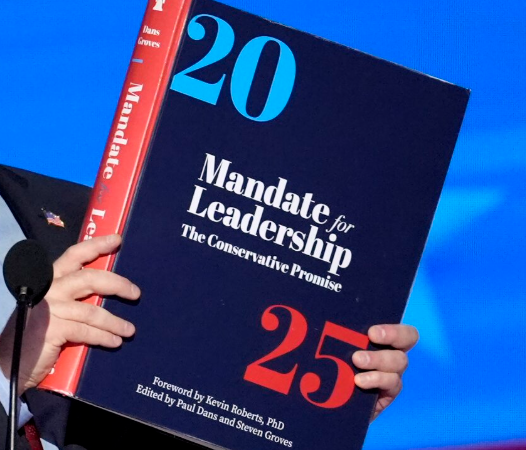
In April 2023, a group of ultra-conservatives published a manifesto called Project 2025. It details a plan so that, in the event that Donald Trump wins the presidential election, he can fire all officials who are not loyal to him and replace them with convinced Trumpists. The Heritage Foundation, a signatory to the document, describes the federal administration as liberal-leaning and hostile to Trump's MAGA policies. To avoid the restraint that Trump “suffered” during the 2016-2020 period, they propose the massive dismissal of tens of thousands of civil servants. The pretext used to legitimize this ideologization of the civil service is the fight against the Deep State, that undefined mass of corrupt officials who conspire against Christian, conservative values and against the American middle class.
This measure would not be novel in the world; Erdoğan himself dismissed some 135,000 civil servants during two years of state of emergency following the 2016 coup attempt. Other European countries, such as Poland or Hungary, have already tried; and some, succeeded. In the Polish case, we find the political crisis initiated by PiS, the party that governed from 2014 to 2022. This ultra-conservative party pushed for measures to be able to control the election of all judges, who were to depend directly on the Minister of Justice. The other case is that of Viktor Orbán, who was more successful than his Visegrad partner. Through a reform in the labor legislation of civil servants (Law 199/2011 and Law 1/2012 of the new Labor Code), he included a flexibilization clause that allows him to fire them freely.

Considering the great cultural and political influence that the United States exerts over the rest of the world, the application of the theory of unitary executive power in that country could have fatal consequences for the rest of the democracies. Trump's arrival in 2016 gave rise to the normalization of the radical right and its ideas around the world, as well as a way of doing politics that breaks with democratic consensuses. So his revalidation in the White House, having been shielded by the Supreme Court with the sentence published in July 2024 granting him immunity in acts as President, promises a more untied presidency than the previous one.


Comments